

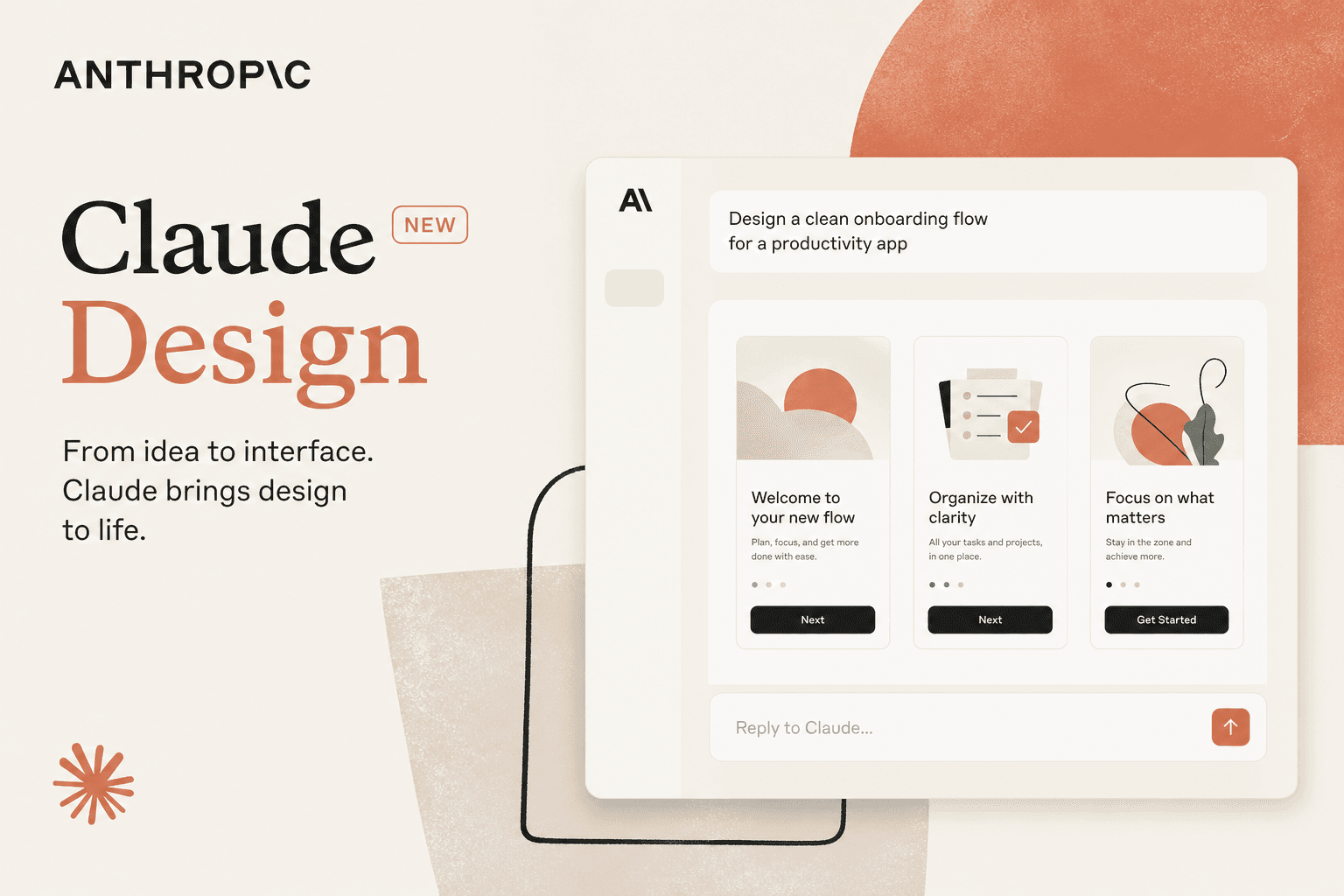
Claude Design: Anthropic's Biggest Bet on AI and Creativity
For years, AI in the design world meant one of two things: generating images with Midjourney, or asking ChatGPT to write copy. The actual craft of design — layouts, component hierarchies, spacing systems, brand reasoning — remained stubbornly human.
Anthropic just changed that.
Claude Design is Anthropic's latest release, and it's a serious push into the creative and product design space. Not a gimmick. Not a wrapper around Stable Diffusion. A genuine attempt to bring Claude's reasoning capabilities into the visual and structural work that designers and product teams do every day.
What Claude Design Actually Does
Claude Design isn't an image generator. Think of it as a design-aware reasoning layer — one that understands visual structure, UI patterns, design systems, and the intent behind creative decisions.
In practical terms, it can:
- Review and critique UI mockups — Upload a screen and Claude Design will analyze hierarchy, spacing, accessibility, and visual flow with the depth of a senior product designer.
- Generate structured design briefs — Describe a product idea and it outputs a full brief: user personas, key flows, design principles, and component recommendations.
- Reason about design systems — Ask it how a new component fits into an existing system, and it explains the trade-offs. Light/dark mode variants, responsive behavior, token naming — it handles the nuance.
- Write production-ready UI code from design intent — Unlike tools that convert a screenshot pixel-by-pixel, Claude Design understands why something was designed a certain way and generates code that reflects that intent.
Why This Is Different
Most "AI for design" tools are really AI for assets — they generate images, icons, or illustrations. Claude Design is trying to do something harder: reason about design as a discipline.
Anthropic's bet is that the limiting factor in design isn't raw creative output. It's the thinking that happens between the brief and the final product — the decisions about information architecture, the debates about component reuse, the trade-offs between aesthetics and accessibility. That's where Claude's reasoning strength has room to genuinely help.
A designer who can articulate what they want in plain English — and get back a structured, reasoned response rather than a pretty picture — has a real accelerant in their workflow.
What It Means for Design Teams
The immediate impact will be felt by small and mid-sized product teams. Startups that can't afford a dedicated UX researcher, a design systems engineer, and a senior product designer all at once now have something that can partially fill those gaps.
For larger teams, the value is in speed. Claude Design can review a mockup in seconds, catch accessibility issues before they reach engineering, and generate documentation for design decisions that usually go undocumented.
What it doesn't replace is taste. The instinct a great designer has — knowing when something feels off even if it checks every technical box — that's still human. Claude Design is a tool for the thinking parts of design, not the feeling parts.
What Designers Are Saying
Reactions in the design community have been mixed in the way that always happens when a capable AI enters a creative field. Some designers see it as a genuine productivity unlock. Others are skeptical until they see how it handles the messy, contextual decisions that dominate real projects.
The honest answer is that it will depend on how it's used. A designer who treats it as a reasoning partner — challenging its output, pushing back, using it to stress-test their own thinking — will get more out of it than one who treats it as an oracle.
The Broader Picture
Claude Design is part of a clear pattern from Anthropic. Rather than building a single general-purpose chatbot, they're going deep into specific professional domains — coding with Claude Code, now design with Claude Design, and almost certainly more verticals to come.
The strategy makes sense. Domain-specific depth beats general breadth when professionals are choosing tools for serious work. A designer doesn't want a chatbot that can "also" help with design. They want something built for the way they actually think and work.
Whether Claude Design becomes the design world's version of Cursor — a tool professionals genuinely center their workflow around — is the question worth watching over the next twelve months.
We'll be watching closely. Follow Kohminds for more coverage on the AI tools reshaping how products get built.
Ready to transform your business?
Looking to implement this in your business? Explore our AI Integration & Development to build production-ready solutions.
Explore Our Services